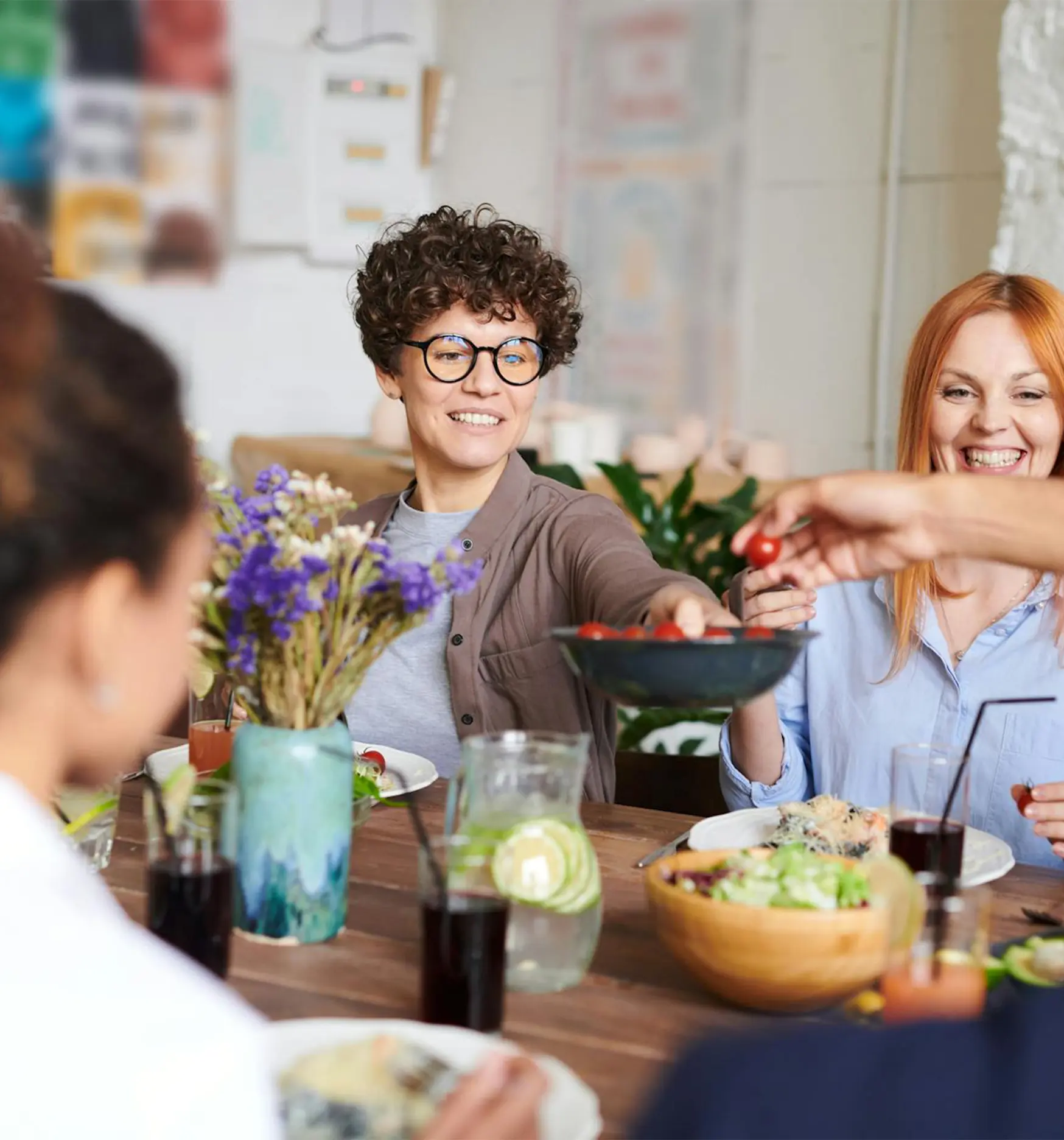
Lockdown, the closure of places to live together, the limitation of travel, the persistence of a virus and its variants are testing our well-being together. Collective and convivial meals around the same table, bringing together friends, family, colleagues, etc., are now almost non-existent or highly restricted.
However, in this anxiety-provoking atmosphere and from our more or less comfortable intimate interiors, our desires to meet others over a drink, on a terrace, in a bistro, around a feast are increased tenfold.
Thus, the isolation experienced by each and every one of us as well as the perceived lack of sociability highlight the eminent role that restaurants and restaurant owners play in animating our social lives.
Based on these observations, several cooking enthusiasts launched the “Everyone at the Table!” movement. Through the creation of pairs between chefs and inspiring people who are passionate about cooking, TLMAT! aims to recreate social ties by projecting us today into our collective return to the table. To define our goals, we needed to better understand how the Covid-19 crisis has shaken this very important aspect of our lives. So we conducted a survey of 83 people ranging from 18 to over 60 to understand how the crisis has changed the way they think, live and share meals. The answers also allow us to know what the public expects from a project such as ours in order to continue to build it all together.
The survey results highlight several trends. To the question “what has Covid-19 changed, in concrete terms, in the way you experience meals?” ”, a very significant portion of respondents deplore the tightening of their social circle during meals. For some, it is the lack of “sharing and conviviality” that affects them the most, others evoke “the distance at the table, in the family, for fear of being infected”.
This discomfort is expressed in several ways. When asked “what do you hope for the future in terms of meals?” ”, a woman in her forties hopes to one day “find large tables again without being afraid of a postillion”. But in addition to meals with friends and the abandonment of barrier gestures, many respondents start dreaming of a “return to the restaurant”. Some expect awareness, like an entrepreneur who wants “people to realize the importance of sharing.”
Whether they express discomfort or hope, almost all of the responses received point to the fundamental importance of eating together.
Sharing food has always been a way to strengthen the links between the actors involved in this sharing. Conversely, resistance to sharing creates a form of distance and hostility. Commensality, the act of eating together, thus counts as an important socialization agent. (Bloch, 2010)
For Jean-Sébastien Philippart, professor of philosophy and theology, Eating together proves to be structuring. He considers that women and men are beings in relationships and that these relationships will take shape, in a privileged way, with the concrete experience of sharing. Based on this, when a person is at the table with others, they are not only nourished by food, but by relationships that take place at the table. For 75% of our respondents, meeting up to eat together strengthens social ties and fights against isolation. Consequently, it is not only a question of feeding oneself in order to live physically, but it is also a question of feeding oneself in order to build and develop one's belonging to a group, to identify oneself as an individual and as an individual within the group. (Philippart, 2011)
In addition, research from the University of Oxford found that the more people eat with others, the more likely they are to feel happy and satisfied with their lives. The results suggest that commensality increases a sense of well-being and reinforces a sense of satisfaction and integration within the community. People who share the same meal are more likely to feel better about themselves and to have a wider social network that can provide social and emotional support. (Dunbar, 2017)
Robin Dunbar, one of the psychology professors who participated in the study, considers that endorphinic stimulation at the level of the nervous system is favored by the sharing of food. These mood-elevating opioids are not only released during the act of eating, but also whenever we have satisfying social relationships. (Dunbar, 2010).
In addition, endorphins are not the only hormones that are secreted when sharing meals. A study conducted at the Max Planck Institute on the relationships of humans, chimpanzees, demonstrated that urinary oxytocin levels in unrelated chimpanzees after sharing food were higher than after grooming, another cooperative behavior.
This implies that sharing food may be a more important agent than other cooperative behaviors in promoting social relationships. By reproducing the same neurobiological mechanisms as those developed during the consolidation of the mother-child bond during lactation, food sharing could be the reason for the initiation of cooperative relationships between adult chimpanzees, both related and unrelated (Roman Wittig, 2014).
Brillat-Savarin (1825, 160-164) defines conviviality as “the pleasure of sharing the table”. In this sense, the word “conviviality” refers to anyone who finds particular pleasure in sharing a good meal with others, fuelled by conversations and reflections. This is part of Living Together, of the fundamental human need to share, to exchange and to be in community, but above all to forge friendly relationships. In our survey, 94% of respondents say they “strongly agree” with the fact that meeting up to eat together is useful for sharing and having fun together. Eating is nourishing the body, while friendship nourishes the spirit, hence this non-arbitrary association (Corbeau, 2002, 97). This friendly environment maintains a form of collective happiness, where the well-being of each person blossoms in the resonance of the well-being of others. (Salome, 2005).
The “pleasure of the table” cannot be limited to the simple taste of food. However, we often talk about a certain “staging” of the meal, which varies from one society to another. This dramaturgical layout involves food presentation, taste behaviors, and table etiquette that operate in a sensory, empathetic as well as communicative (verbal and non-verbal) manner. Thus, eating in company is by nature a kind of dialogue, where each guest is the main actor (Barthes, 1975, 12). Indeed, according to one of our respondents, “it does not matter where [the meal] is served, as long as it is shared with other people with whom we discuss everything, regardless of the subject, regardless of the nature of the meals.”
Eating together is therefore sharing much more than just food. It's sharing a moment, taking part in a production and forging social relationships. But commensality doesn't start when the lunch bell rings, it starts long before that. Each meal requires preparations and these can already be the start of a great sharing experience...
According to Emmanuelle Turquet, founder of kitchen-therapy, cooking together helps to consolidate and deepen the relationship between the people concerned through the cooperation that this requires: choosing the menu, distributing tasks, acting and moving in harmony in the kitchen, sharing utensils, etc. Cooking with four hands has a familiar character, which, when it is part of daily life, allows individuals to come together in harmony.
Cooking with others is in a nutshell, introducing yourself to your world, opening yourself to your mind and engaging each other with mutual aid and solidarity. It is a real exercise in letting go: it is a question of accepting to do things differently, of integrating the partner's “know-how”, his desires and his techniques for preparing the meal. (Turquet, 2020)
In addition, Racine and St-Onge's research on collective kitchens in Quebec shows that taking initiatives while respecting the structure of the group increases the autonomy of the protagonists. So, by sharing their ideas and being actively involved in culinary creation, their sense of personal effectiveness increases. As a result, cooking together in a positive group dynamic leads to greater self-esteem among group members as well as a sense of accomplishment and a greater sense of self-worth. (Racine and St-Onge, 2000).
Finally, cooking for others is rewarding for cooks on a personal level. According to Julie Ohana, a kitchen therapy therapist, altruistic cooking builds a sense of self-confidence and self-appreciation. In this case, the sense of accomplishment of cooks is not the only fruit of the altruistic act, but is also linked to the fact of contributing in a basic way to keep alive. (Ohana,2017).
So eating together seems to have a lot of positive effects. It is because eating is intimate that sharing this moment with the other person can be so precious; but that is also why it can be difficult to let go. Because sharing a meal also means submitting to the gaze of the other and therefore risking feeling social pressure.
In general, we tend to eat more when there are several of us at the table. Under collective influence, we tend to succumb to the desires of others, for example, we evaluate the menu differently when we are out with friends at a restaurant than when we are alone. Doing like the other person implicitly means being in sync with the group, in a way seeking to belong.
In addition, a study published in the journal Evolutionary Psychological Science shows that men respond more to their hunger in the presence of women. Indeed, this enthusiasm for appetite is “a way to assert their superiority” as well as a way to impress. (Kniffin, 2016)
On the other hand, group presence can also be a source of hindrance for some. Dr. Helen Ruddock, director of research in psychology at the University of Birmingham, conducted research that assumes that we often choose what to eat (and how much) based on the type of impression we want to convey about ourselves. Women, in particular, would adopt restrictive eating behaviors in the presence of other guests; they do not give much importance to their taste desires during shared meals (Ruddock, 2019).
Also, some people with eating disorders fear being criticized for their food choices. In the extreme case, this discomfort results in total inhibition: forbidding yourself to eat in the presence of the other person, or even making conscious efforts to avoid such sharing situations. Finally, eating with each other raises the fear of feeling judged because of facial deformities or chewing noises, which can be very embarrassing for some. (Turquet, 2020)
“We don't sit at the table to eat, but to eat together,” writes Plutarch. This quote echoes the results of this research. As we analyzed the data collected from the questionnaire, we noted the frequent use, among respondents, of the terms “friends” (47 times) and “family” (39 times) to describe their ideal meal. Indeed, we can deduce that the meal, in their imagination, is more about a moment shared with loved ones than with food intake. Meals not only represent the simple act of eating, but very often take the form of an intimate and convivial situation that can take place in several moments: first, cooking, then setting the table and finally, exchanging with loved ones, thus constituting moments of the meal in their own right. In light of these elements, Everyone at the Table! aims mainly to revalue these moments that have been erased by the health context in favor of the purely dietary dimension of the meal.
Answers collected to the question “What do you think of a movement like Everyone at the Table! can bring? “
Bloch, Maurice. “Commensality and Poisoning.”, La Pensée de Midi, vol. 30, no. 1, 2010, 81-89. doi.org/10.3917/lpm.030.0081
Brillat-Savarin, Jean-Anthelme. Physiology of taste or meditations of transcendent gastronomy, Lacour, 1999, original edition 1825.
Brillat-Savarin, Jean-Anthelme. Physiology of taste, edition put in order and annotated, with a reading by Roland Barthes, Hermann, 1975, original edition 1825.
Corbeau, Jean-Pierre, Jean-Pierre, Poulain. Think about food. Between the imaginary and rationality, Privat, 2002.
Dunbar, R.I.M. “Breaking Bread: The Functions of Social Eating.” Adaptive Human Behavior and Physiology 3, March 11, 2017, 198-211. Springerlink, doi.org/10.1007/s40750-017-0061-4
Dunbar, R.I.M., “The social role of touch in humans and primates: Behavioural function and neurobiological mechanisms.” Neuroscience & Biobehavioral Reviews, vol. 34, no. 2, Feb. 2, Feb. 2010, 260-268. ScienceDirect, doi.org/10.1016/j.neubiorev.2008.07.001
Knifing, Kevin M, et al. “Eating Heavily: Men Eat More in the Company of Women.” Evolutionary Psychological Science, vol. 2, March 2016, 2016, 38—46. Springerlink, doi.org/10.1007/s40806-015-0035-3
Ohana, Julie. “The Very Real Psychological Benefits of Cooking For Other People,” Huffpost, Oct. 17, 2017, huffpost.com/entry/benefits-of-cooking-for-others_n_5967858ae4b0a0c6f1e67a15
Philippart, Jean-Sébastien. “Commensality: an exemplary shaping of being in common”, Monde Francophones, 26 Apr. 2011, mondesfrancophones.com/spaces/philosophyes/la-commensalite-a-commensalite-a-the-example-formation-of-being-in-commun/
Racine, S., and St-Onge, M. “Collective kitchens: a path to mental health promotion.” Canadian Journal of Community Mental Health, 19 (1), 2000, 2000, 37-62.
Ruddock, Helen K. “A systematic review and meta-analysis of the social facilitation of eating.” The American Journal of Clinical Nutrition, vol. 110, no. 4, Oct. 2019, Oct. 2019, 842—861. Oxford Academy, doi.org/10.1093/ajcn/nqz155
Salomé, Jacques. “Passport to wellness”, J-Salomé, Feb. 2005, j-salome.com/ archives?date=2005
Turquet, Emmanuelle. “Are we only friends when we eat together? ”, kitchen-therapy, 2020, kitchen-therapie.com/on-nest-friends-when-we-eat-together/
Turquet, Emmanuelle. “Not always easy to eat together”, kitchen-therapy, 2020, kitchen-therapie.com/pas-always-simple-de-eating-together/ Witting, Roman M, et al. “Food sharing is linked to urinary oxytocin levels and bonding in related and unrelated wild chimpanzees.” Proceeding of the royal society B, 281:20133096, March 7, 2014. doi.org/10.10989 /rspb.2013.3096




A selection of articles to extend the reflection, discover other points of view and make your ideas grow.