In the run-up to the European elections which will take place in June, and in a context where major demonstrations by farmers have occurred in recent months, particularly in France, the Common Agricultural Policy (CAP) is the subject of intense controversy. Faced with the dichotomous discourse carried by the extreme right, opposing the interests of farmers to ecological issues, Hugo Specht wanted to defend in this article the feasibility of a Europe of food consisting in strengthening support for farmers, while accelerating the transition to a sustainable agricultural model that respects the environment and health.
The CAP is a European Union (EU) policy dedicated to agriculture and rural development, introduced in 1962. Originally, its objective was to increase agricultural production to feed the European population, in the post-war context. To achieve this objective, three main instruments have been established:
The CAP quickly exceeded its initial objective, even leading to the overproduction of many products. This phenomenon was quickly identified as a problem causing additional costs — as costs for the EU increased in parallel with production — and causing waste.
To meet these challenges, the CAP has undergone numerous reforms, including a major one in 1992, aimed at resolving the various dysfunctions. For example, the price guarantee has gradually been replaced by a system of direct aid to farmers, partially decoupled from production, in order to reduce overproduction and promote more environmentally friendly agriculture. In the same perspective, quotas have for example been introduced to limit the production of milk and milk products, thus reducing surpluses and stabilizing prices.
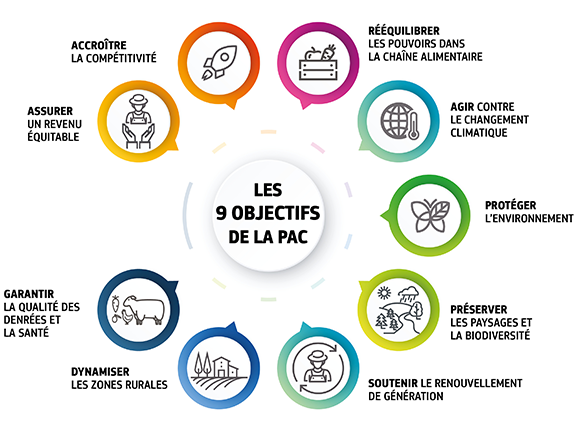
The CAP is divided into two parts, each with different objectives and modes of operation.[1] :
Representing more than 70% of the CAP budget, it allocates direct payments to farmers, and measures to support agricultural markets. It aims to ensure a stable income for farmers and to help them cope with price and market fluctuations.
Established in 2003, the objective of rural development policy is to maintain the socio-economic dynamism of rural areas, while helping farmers to face the environmental challenge, in particular by supporting the conversion to organic farming.
[1] 'CAP instruments and their reforms | Thematic factsheets on the European Union', European Parliament, 30 September 2023
Source INRAE:
While this European Policy is more or less criticized across the EU, the criticisms made by the agricultural world have been particularly strong in France in recent months.
In France, the CAP is managed by the Ministry of Agriculture and Food Sovereignty, as well as in part by the Regions for what currently falls under the second pillar — rural development. Although France is the EU Member State that benefits the most from the CAP budget, receiving around 9 billion euros per year[1], the poor distribution of financing has the consequence of not benefiting enough farmers of moderate size, often burdened with debts, and having the feeling of being out of breath.
Therefore, as currently thought, the CAP does not succeed in embodying a sustainable and united European agricultural project. The questionable allocation of resources, combined with the support of a productivist industrial model, contributes to the destruction of biodiversity and jobs.
[1] 'European agricultural standards: distinguishing what's true from what's false! ' , European Commission
In a context of protests that started in France, and have spread to several European countries, the European Parliament has paved the way for the rapid approval of the relaxation of certain environmental requirements of the CAP for the period 2023-2027[1], thus complying with the dialectic imposed by a part of the political class that seeks to oppose the interests of agricultural workers to the environmental emergency[2].
Indeed, on 15 March last year, the European executive proposed two regulations modifying six of the nine standards relating to good agricultural and environmental conditions (BCAE) on which payments made under the CAP are based, and by giving Member States greater flexibility in implementing this policy.
[1] Maria Simon Arboleas, 'Relaxation of the environmental requirements of the CAP: NGOs warn against a 'poisonous gift', EURACTIV, 12 April 2024
[2] Hugo Struna, 'Jordan Bardella wants to change European agricultural policy “from within” ', EURACTIV, 26 February 2024
In such a context, AlterMakers defends the idea of a new CAP that would meet the expectations of farmers, and that would not neglect environmental standards. Therefore, I particularly want to support the solutions defended by the collective. For another PAC[1], whose main demand is to support a Policy that focuses more on medium-sized farms, and offers better support to farmers seeking to reduce their environmental footprint[2]. In concrete terms, this would result in a transfer of part of the budget allocated to the first pillar to the second pillar, which is considered more fair in its mechanism for distributing funding.
While Regions already play a certain role in the allocation of CAP aid[3], and that the Member States gained greater autonomy during the last reform[4], some actors believe that the CAP remains too centralized. Indeed, increasing the role of regional institutions would be a way of providing more specific assistance to farmers, whose challenges differ from one country and from one region to another.[5].
The redistributive payment currently makes it possible to better remunerate the first 52 hectares of a farm, thus favoring moderately sized farms. In 2020, it represented only 10% of the first pillar envelope[6]. AlterMakers therefore recommends increasing this envelope, as well as distributing the value of the redistributive payment into three categories, in order to further protect small producers: maximum value for the first 10 hectares, intermediate value for hectares from 10 to 25, and low value for hectares from 25 to 52.
Introduced in 2018, eco-regimes are supposed to allow 30% of the first pillar to be paid, subject to compliance with certain environmental practices.[7]. In fact, this mechanism has not had the expected positive consequences on the environment in recent years, due to imprecise and gradual implementation. Thus, we defend an eco-regime at several levels, in order to modulate the value of the payment according to the ambition of the valued practice. To encourage investments in the transition, the budgets allocated to this eco-regime must also be increased.
The ICHN, mostly paid to livestock farms in mountain areas or areas with low agronomic potential, is crucial to maintain agricultural activity and the maintenance of landscapes in these regions. To ensure the survival of agricultural production throughout Europe, and support the development of short supply chains, the CAP must protect farms operating in difficult conditions.
Likewise, the conversion to organic farming often raises legitimate fears among farmers, who fear that they will not be able to make their investments profitable. As such, the EU must make budgetary efforts to accelerate conversions, and prevent deconversions.
Investment grants can promote the transition and territorial food sovereignty, if they are not used for non-virtuous purposes. Thus, AlterMakers emphasizes that these aids must be more conditional on agroecological projects, on taking into account animal welfare, or even on reducing the arduousness of the work of workers.
Concretely, this aid could, for example, be used to modify a pigsty to convert pigs from integral grating to pigs on litter, to invest in market gardening equipment, or even in the modernization of a milking parlor. On the agroecological level, this aid could allow ruminants to be cultivated (via the financing of paths) or the stopping of chemical weed control (via the purchase of mechanical weeding equipment).
[1] For another PAC (former platform incorporated into the Nourriger Collective) worked from 2018 to 2022 on the reform of the post-2020 CAP, from the development of the regulation at the European level to its implementation at the French level. This platform brings together environmental NGOs and farmers' associations.
[2] 'What National Strategic Plan for the 2023-2027 CAP in France? ' (For another CAP, 2021)
[3] 'PAC 2021-2027: role of states and regions', Public Life, 13 October 2020
[4] Editorial All Europe, 'What is the European Union's Common Agricultural Policy (CAP)? ' , Touteleurope.eu, May 13, 2024
[5] 'Reinventing the European Union's agricultural policy: a call for decentralisation', EU Reporter, 14 May 2024
[6] Op. Cit. , For another PAC.
[7] Ibid.
Decoupled payments are justified as the “first safety net” for farmers. However, over the last few years, we have seen that they have harmful consequences for the EU's agricultural and food system, and that they mostly benefit large agro-industrial companies. Indeed, decoupled aid is often indirect support for real estate capital, which is not justified either from the point of view of employment or the environment, as pointed out by INRAE.[1].
In the same perspective, operational programmes are payment systems designed for long chains, largely oriented towards exports.
For example, the program in favor of fresh fruits and vegetables greatly benefits Cerafel and Savéol, two agribusiness giants producing fruits and vegetables grown above ground, in heated greenhouses.[2]. At the same time, the operational programmes do not award specific aid to market gardeners and field arborists. Transferring part of the budget, or even all of it, to the measures of the second pillar therefore seems to be an excellent way to find funding to support a healthy, inclusive and sustainable Europe of food.
[1] 'How does the CAP support farmers' incomes? ' , INRAE, 2021
[2] Laurie Debove, 'BASTA: these agribusiness giants who benefit from public aid from the PAC', La Relève et La Peste, 13 January 2021
Although the CAP is now considered to be one of the most divisive policies in the EU, AlterMakers stresses that it is not destined to crystallize a debate opposing farmers to ecological issues. This article aims on the one hand to recall that this dialectic is the result of a political construction carried out by the fringes of the extreme right, and on the other hand to present concrete solutions that would make it possible to reconcile fairer support for farmers and the development of a sustainable model that is healthy for health and the environment.